Affiliate Disclosure: We may earn a commission from qualifying purchases made through links on this page, at no extra cost to you. This helps us maintain our site and provide free content. Read our full affiliate disclosure.
Burr vs. Blade Grinders: Why It Matters
Is a burr grinder really worth the extra money? We compare the two most common types of coffee grinders to see which one wins.
How We Compare Products
We compare products based on objective criteria, specifications, and user feedback to help you make informed decisions.
Our Evaluation Criteria
Value & Price
We consider both budget-friendly and premium options, evaluating whether products offer good value for their price point.
Features & Specifications
We analyze product specifications, features, and capabilities to ensure they meet the needs of our target audience.
User Reviews & Feedback
We research user reviews, ratings, and feedback from multiple sources to understand real-world performance and reliability.
Build Quality & Durability
We evaluate materials, construction, and durability based on manufacturer information and user reports.
Brand Reputation
We consider brand reputation, customer service, and warranty support when making recommendations.
Use Case Fit
We match products to specific use cases and brewing methods to ensure our recommendations are relevant and practical.
Note: We do not accept payment or free products in exchange for positive reviews. Our recommendations are based solely on our evaluation criteria and research. For more details, see our About page and Affiliate Disclosure.
If you're still using a blade grinder, you're missing out on the true potential of your coffee beans. Here's why the "burr vs. blade" debate is so one-sided in the specialty coffee world.
The grinder is arguably the most important piece of coffee equipment you can own. While your brewing method matters, the consistency of your grind size directly impacts extraction, which determines the final flavor of your coffee. Understanding the fundamental differences between burr and blade grinders will help you make an informed decision that elevates your coffee experience.
Why Grind Consistency Matters
Before diving into the differences between burr and blade grinders, it's essential to understand why grind consistency is so crucial. When coffee grounds are uniform in size, water extracts flavors evenly. Inconsistent grind sizes lead to over-extraction (bitter, astringent flavors) from fine particles and under-extraction (sour, weak flavors) from large particles.
Think of it like cooking pasta: if you have some pieces that are perfectly al dente and others that are mushy, the dish won't taste right. The same principle applies to coffee extraction. A consistent grind size ensures that all coffee particles extract at the same rate, resulting in a balanced, flavorful cup.
If you're ready to upgrade right away, our best coffee grinders for pour-over shortlist narrows the field quickly. And if your choice is down to two of the most common electric options, start with Baratza Encore vs. Fellow Opus.
Blade Grinders: The "Blender" Approach
Blade grinders are the most common type of coffee grinder found in households. They work by using a spinning blade (similar to a blender) to chop coffee beans into smaller pieces. While they're affordable and compact, they have significant limitations that affect coffee quality.
How Blade Grinders Work
When you press the button on a blade grinder, a metal blade spins at high speed, chopping the beans into smaller pieces. The longer you grind, the finer the particles become. However, this process is inherently inconsistent because:
- Random Chopping: The blade randomly chops beans, creating particles of various sizes
- No Control: You can't adjust the grind size precisely
- Heat Generation: The friction from the spinning blade generates heat, which can "cook" the coffee beans and destroy delicate flavor compounds
Pros of Blade Grinders
- Affordability: Blade grinders are extremely cheap, typically costing $10-$30
- Compact Size: They take up minimal counter space and are easy to store
- Simple Operation: Just press a button and grind
- Versatility: Can be used for spices and other ingredients
Cons of Blade Grinders
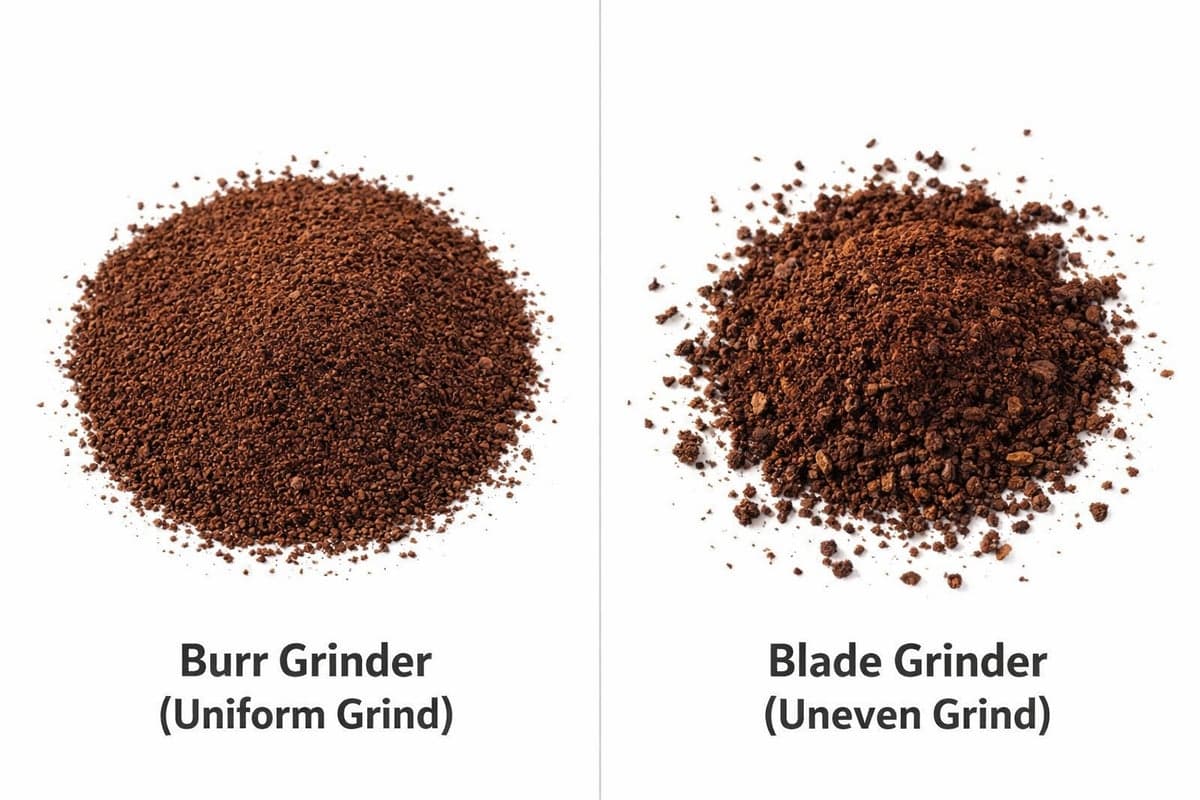
- Inconsistent Grind Size: Creates a mix of fine dust, medium particles, and large boulders
- Heat Generation: The friction heats the beans, potentially burning delicate flavors
- No Precision: Impossible to achieve a specific grind size for different brewing methods
- Static Electricity: Fine particles can stick to the grinder and container
- Short Grinding Time: Requires multiple short pulses to avoid overheating, making it time-consuming
Real-World Impact
When you use a blade grinder, you're essentially creating a mix of different grind sizes in every batch. This means:
- Some particles extract too quickly (over-extraction = bitterness)
- Some particles don't extract enough (under-extraction = sourness)
- The result is a muddled, unbalanced cup of coffee
Even if you start with the finest specialty coffee beans, a blade grinder will prevent you from experiencing their true potential.
Burr Grinders: The "Mill" Approach
Burr grinders use two revolving abrasive surfaces (burrs) to crush coffee beans into uniform particles. This method provides precise control over grind size and produces consistent results that are essential for quality coffee extraction.
How Burr Grinders Work
Burr grinders come in two main types:
- Flat Burr Grinders: Two flat, circular burrs sit parallel to each other. One rotates while the other remains stationary.
- Conical Burr Grinders: A cone-shaped burr sits inside a ring-shaped burr. The cone rotates, crushing beans between the two surfaces.
Both types work by crushing beans between two abrasive surfaces, creating uniform particles. The distance between the burrs determines the grind size, which can be precisely adjusted.
Types of Burr Grinders
Electric Burr Grinders:
- Powered by an electric motor
- Faster and more convenient
- Range from $50-$500+ depending on quality
- Best for daily use and espresso grinding
Manual Burr Grinders:
- Hand-cranked operation
- More affordable ($20-$100)
- Portable and quiet
- Excellent grind quality for the price
- Great for travel and pour-over brewing
Pros of Burr Grinders
- Consistent Grind Size: Produces uniform particles for even extraction
- Precise Control: Adjustable grind settings for different brewing methods
- No Heat Generation: Crushing action doesn't generate significant heat
- Better Flavor: Preserves delicate flavor compounds in specialty coffee
- Versatility: Can grind for espresso, pour-over, French Press, and everything in between
- Durability: Well-built burr grinders can last decades
Cons of Burr Grinders
- Higher Cost: Entry-level burr grinders start around $50, quality models cost $200+
- Larger Size: Take up more counter space than blade grinders
- Maintenance: Burrs need occasional cleaning and may need replacement after years of use
- Slower (Manual): Hand-cranked models require more time and effort
Real-World Impact
With a burr grinder, you get:
- Uniform particle size = even extraction = balanced flavor
- Ability to dial in the perfect grind for your brewing method
- Preservation of delicate flavor notes in specialty coffee
- Consistent results every time you brew
The difference is immediately noticeable. Your coffee will taste cleaner, more balanced, and more complex. You'll be able to taste the specific flavor notes described on your coffee bag, rather than a muddled mix of over and under-extracted flavors.
The Science Behind the Difference
The fundamental difference between burr and blade grinders comes down to particle size distribution. Research in coffee extraction has shown that:
-
Uniform Particles = Better Extraction: When all particles are the same size, they extract at the same rate, creating a balanced cup.
-
Mixed Sizes = Poor Extraction: A mix of fine and coarse particles means some extract too much (bitter) while others extract too little (sour).
-
Heat Damage: Blade grinders can heat beans to 70-80°C (158-176°F) during grinding, which can destroy volatile flavor compounds. Burr grinders typically stay below 30°C (86°F).
-
Oxidation: The inconsistent chopping of blade grinders creates more surface area exposed to oxygen, accelerating staling.
The Verdict
If you care about the taste of your coffee, a burr grinder is the single best investment you can make. Even a cheap manual burr grinder will outperform the most expensive blade grinder. The difference in coffee quality is dramatic and immediate.
For Budget-Conscious Buyers: A manual burr grinder like the 1Zpresso JX ($80-$100) will produce better coffee than any blade grinder, regardless of price.
For Daily Use: An electric burr grinder like the Baratza Encore ($150-$170) is the minimum for serious home coffee brewing.
For Espresso: You'll need a burr grinder with fine adjustment capabilities. Check out our top burr grinders under $200 for budget-friendly recommendations that can handle espresso.
Ready to make the switch? Check out our top burr grinders under $200 for budget-friendly recommendations.
Once you have your grinder, the next step is choosing the right brewing method. Our French Press vs. AeroPress comparison and best pour-over coffee makers guide will help you find the perfect match for your grinder.
What's next? Once you have a quality grinder, you'll want to pair it with the right brewing method. If you're interested in espresso, check out our best espresso machines for beginners. For manual brewing, our French Press vs. AeroPress comparison will help you choose. And don't forget—great coffee starts with great beans. Learn how to choose the right coffee beans for your preferred method.
Who This Is For
This guide is perfect for:
- Budget-conscious coffee drinkers wondering where to spend their first $50-$100
- Anyone currently using a blade grinder and experiencing inconsistent coffee
- Coffee enthusiasts looking to understand why their expensive beans don't taste as good as expected
- Beginners who want to start their coffee journey with the right equipment
Want more comparisons? Browse all our product comparisons to help you choose the right equipment.
FAQs
Can I make good coffee with a blade grinder?
While you can make drinkable coffee with a blade grinder, you'll never achieve the full potential of your beans. The inconsistent grind size will always result in a muddled flavor profile. If you're serious about coffee quality, a burr grinder is essential.
How much should I spend on my first burr grinder?
For manual grinders, expect to spend $50-$100 for quality. For electric grinders, the Baratza Encore at $150 is the minimum for serious home brewing. Espresso-capable grinders start around $200.
Do I need different grind sizes for different brewing methods?
Yes! Espresso requires a very fine grind, French Press needs a coarse grind, and pour-over needs a medium-fine grind. A burr grinder allows you to adjust for each method, while a blade grinder cannot.
Can I use a blade grinder if I'm just starting out?
While a blade grinder is better than pre-ground coffee, upgrading to even a cheap manual burr grinder will dramatically improve your coffee quality. Consider it an essential investment if you're serious about home coffee brewing.
How long do burr grinders last?
Quality burr grinders can last 10-20 years with proper maintenance. The burrs may need replacement after 5-10 years of heavy use, but the machines themselves are built to last.
Best next step
Compare picks and prices before you decide
If you are weighing a purchase after this guide, these shortlist and head-to-head pages are the fastest next read.
Related Articles
Paper vs. Metal Filters: How They Affect Coffee Flavor
The filter you choose has a massive impact on the clarity and body of your coffee. Which one should you be using?
Read Paper vs. Metal Filters: How They Affect Coffee Flavor →Moka Pot vs. Espresso Machine: Real Differences Explained
The Moka Pot is often called a 'stovetop espresso maker,' but is it really espresso? We look at the science of pressure.
Read Moka Pot vs. Espresso Machine: Real Differences Explained →French Press vs. AeroPress: Which One Is Right for You?
Two of the most popular immersion brewers go head-to-head. We compare flavor, ease of use, and cleanup.
Read French Press vs. AeroPress: Which One Is Right for You? →